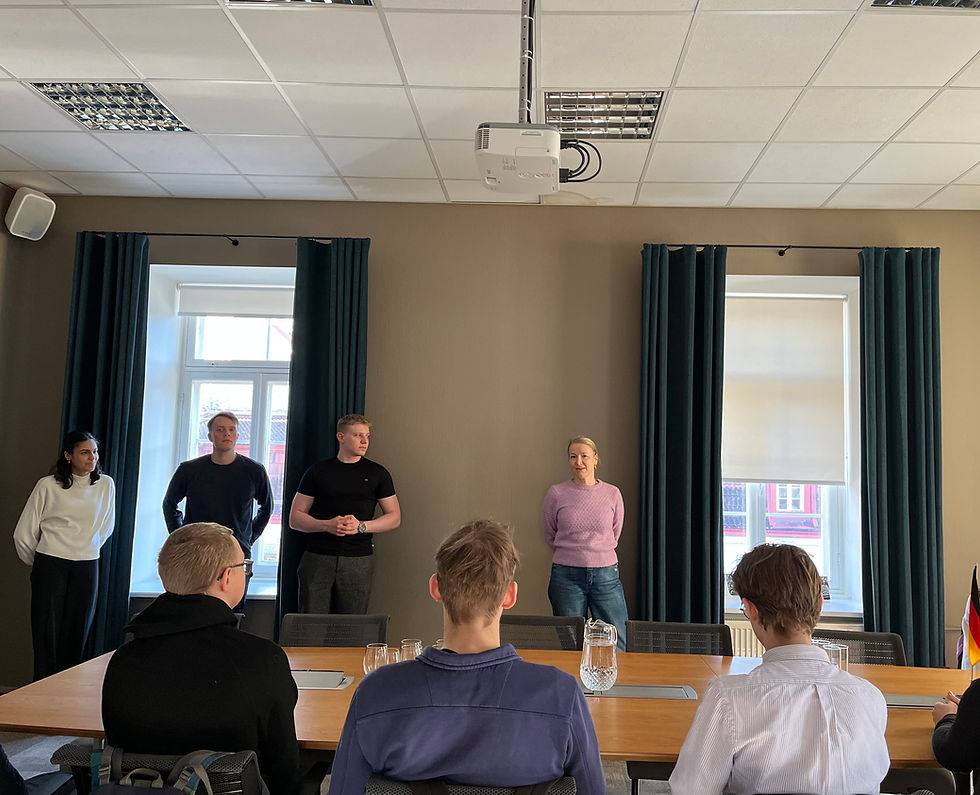
German-Baltic Conference Riga 2025 - Cluster C from the Perspective of a Young Journalist
- Dec 14, 2025
- 5 min read
By Anike Weisenburger. Young Journalist Anike Weisenburger, reporting from Germany, closely shadowed Cluster C: European Security and Discourse during the German-Baltic Conference 2025 in Riga. Her reflections and insights from inside the cluster’s work are captured in the article below.
Security has a human face: Notes from Riga - Cluster C at the German Baltic Conference 2025
It has been two months since the German-Baltic Conference drew to a close, yet the conversations still ring in my ears. In Riga, young people from across Europe worked in three clusters to shape policy proposals that will now travel further towards the European Parliament. I shadowed Cluster C: European Security & Discourse. From the sidelines, I watched the process unfold - listening to how they defined security and seeing how they searched for solutions that could speak to a divided European public.
The Conference, unfolding
The German-Baltic Conference opened at the Latvian National Museum of History, where representatives and partner organisations set a clear security focus for the days ahead. A panel titled “Defending Freedom: Youth Engagement in National and Regional Security” moved the theme from abstract to practical and gave the clusters a common starting point. The lineup brought together policy professionals and practitioners, among them Dr. Benjamin Klasche, who summed up the new reality in “Everything is security, not only wars,” which became a quiet refrain throughout the weekend. The evening closed with a vin d’honneur at the German Embassy.

The next morning began with a keynote by former Ambassador Christoph Eichhorn before the clusters started with their first working sessions. After lunch, Session II continued the drafting. A highlight of the day was a session with Jānis Karlsbergs, Chairman of the Latvian Transatlantic Organisation and Senior Policy and Publications Lead at the NATO StratCom COE.
With more working sessions in the morning and afternoon, Saturday was the “hands-on” day. Between coffee and quick walks outside, teams argued with care. A city scavenger hunt helped break the intensity and gave the groups space to return with fresh eyes, while the cultural dinner that evening restored the energy needed for the final edits.
By Sunday, the work had solidified. The morning brought results presentations and an interactive debate during which each cluster laid out its proposals, and the audience challenged and refined their assumptions. The Young Journalists, myself included, shared reflections and impressions before the closing remarks and our final lunch together.
Inside Cluster C: How a team found its language
Cluster C had started their work already a few weeks before Riga. By the time I joined them on-site, they already shared a rhythm with references exchanged, tasks divided, and drafts under review. Bia, their team lead, gave the group its spirit. She brought a warm energy, encouraged everyone around her, and somehow always stayed one step ahead in planning. Around her, Pascal, Moritz, Camée, Marin, Lizi, Konstantina, and Daria brought different expertise and different maps of Europe.
From their early “finding phase,” one note in my notebook kept resurfacing that words don’t always have the same meaning everywhere. In Central and Eastern Europe, terms like war, threat, and preparedness feel urgent and real, but in parts of Western Europe, the same words can sound abstract, distant, or impersonal. That gap in how we feel language becomes a gap in how we live policy and sits at the heart of Europe’s current struggle over security and unity.

“Security must become personal”
Their policy paper carries a plain, memorable motto that “Security must become personal.” It argues that a credible European approach must bridge the East–West perception gap, counter hybrid threats and disinformation, and invite citizens, especially the youth, into preparedness rather than speaking at them from afar. Watching their sessions from the sidelines, I saw this idea take shape in a few clear directions. One was the vision of a Europe-wide, multilingual storytelling network that would be a trusted space for verified, engaging content shaped for the platforms young people actually use. Its purpose is to humanize distant events, expose manipulation, and give solidarity a face. Another was a central EU dashboard tracking hybrid attacks from sabotage to disinformation. It would help puncture the belief that “nothing is happening here” and build a shared understanding of the pressures on Europe’s information space.
Alongside this, the group shaped what they called a more everyday kind of preparedness. Simple habits and clear guidance at the level of families, classrooms, and local communities make it harder to panic and manipulate citizens because people who feel grounded and informed are less likely to be thrown off balance by fear or misinformation.
They also saw exchange as a form of security in itself. When Europeans actually meet through Erasmus+, town partnerships, or small community projects, they become less distant from one another and therefore easier to understand and defend.
Together, these ideas form the paper’s core message that security begins with people, not just policies.
Stories against war fatigue
A theme that returned in their work is that support for Ukraine remains high overall but has slipped since 2022 among some groups, especially where distance, economic strain, or a sense of endless conflict sets in. Their response is to bring people back into focus. When the war appears only as charts or casualty counts, empathy slips. When it comes through individual stories and faces, that empathy returns and with it, the willingness to back the measures that protect democracy.
West and East: same continent, different weather
With family ties on both sides, I recognized the tension they described. In many parts of Western Europe, Russia’s war can seem far away, something only encountered in news alerts. In Eastern Europe, it feels far closer. The fear is passed down in family stories and traced across old borders. These differences aren’t moral failures or divides, they come from distinct historical experiences. But if Europeans speak past one another, we risk failing together. Cluster C’s proposals read to me as tools for translation between languages and histories, so that Europe can act with enough shared conviction to deter aggression and resist manipulation.
Conversations that shaped the paper
Part of the strength of Cluster C’s process lay in how they engaged beyond their own table. In the acknowledgements of the policy paper, they thank Frederike Kanschat for guidance, Sokol Zeneli for insights that fed into their arguments, and Prof. Dr. Volker Wittpahl and Trinity Brillinger for inputs that helped refine the proposals. In Riga, I saw it in practice. Side conversations after panels and targeted check-ins to stress-test claims that turn into a better paragraph an hour later.

What I’m taking with me
From here, the policy papers will move into European fora, where parts of them may be piloted or debated further. But what stayed with me this week goes beyond proposals. It was the experience of watching Europeans explain their fears to one another, sometimes gently, sometimes with urgency, but always with the hope of being understood.
Because I grew up between Western and Eastern Europe, I know that security is not experienced in the same way everywhere. Those differences don’t dissolve in a conference room, but they can be acknowledged, named, and worked with.
The days in Riga reminded me that bridging this gap is not about reaching perfect agreement, it is more about refusing to look away from each other’s realities. It is slow work, made of listening more than declaring and of accepting that unity grows through recognition, not necessarily uniformity.
And it reminded me why journalism matters here because it can sit in the spaces between perspectives, to translate rather than flatten, and to make sure that the people behind policies remain visible. When we keep stories human and close, distance stops turning into indifference, and Europe has a better chance of standing together when it matters.
The Policy Paper of Cluster C and a visual representation can be downloaded below:

Graphic Artist: Dace Andersone